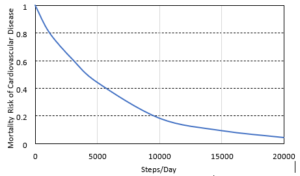
- The risk reduction on increasing the steps/day from 0 to 10000 is less than the risk reduction on increasing the steps/day from 10000 to 20000
- The risk reduction on increasing the steps/day from 0 to 5000 is less than the risk reduction on increasing the steps/day from 15000 to 20000.
- For any 5000 increment in steps/day the largest risk reduction occurs on going from 0 to 5000.
- For any 5000 increment in steps/day the largest risk reduction occurs on going from 15000 to 20000.
Risk reduction value in (0-5000) = 1 – 0.45 = 0.55 which is maximum
- Bicker
- Bog
- Dither
- Dodge
The correct answer is A. Bicker.
Explanation:
The sequence [drizzle → rain → downpour] shows increasing intensity of rain. In the same way, bicker refers to a small, petty argument, which can escalate into a quarrel (a more serious argument), and then into a feud (a long-lasting, intense conflict). The other options (bog, dither, dodge) are unrelated to the progression of arguments or conflict. Hence, “bicker” fits the analogy perfectly.

- Only I and II
- Only II and III
- Only I and III
- Only III
The correct answer is B. Only II and III.
Explanation:
From the statements:
- All heroes are winners.
- All winners are lucky people.
- Inference I (All lucky people are heroes) cannot be deduced because not all lucky people are necessarily heroes.
- Inference II (Some lucky people are heroes) is valid because all heroes are winners, and all winners are lucky people, so some lucky people must be heroes.
- Inference III (Some winners are heroes) is valid because all heroes are winners.
Thus, only inferences II and III can be logically deduced.
- 5
- \(\sqrt{2}\)
- 2
- \(\sqrt{5}\)
Explanation: Let the correct result be \( p \times q \). Instead, the student calculated \( \frac{p}{q} \). Let the percentage error be \( 80\% \). The percentage error can be expressed as: \[ \text{Percentage Error} = \frac{\left( \frac{p}{q} – p \times q \right)}{p \times q} \times 100 \] This simplifies to: \[ 80 = \frac{\left( \frac{p}{q} – p \times q \right)}{p \times q} \times 100 \] Let’s set up the ratio \( \frac{\frac{p}{q}}{p \times q} \), solve it, and use algebra to find that \( q = \sqrt{5} \).
- 1
- 20
- 2
- 1/2
Explanation: The sum of the first \( n \) consecutive odd numbers is given by the formula: \[ S_n = n^2 \] For the first 20 odd numbers: \[ S_{20} = 20^2 = 400 \] Now, divide the sum by 202: \[ \frac{400}{202} = \frac{200}{101} = 1.98 \approx 1 \] So, the result is 1.
- 150
- 200
- 250
- 175
Explanation: Given: – Number of girls in both classes is \( X \). – Total students in 8th class = 450. – Total students in 9th class = 360. The ratio condition is: \[\frac{X}{450 – X} = \frac{360 – X}{X}\] Cross-multiplying and solving: \[X^2 = (450 – X)(360 – X)\] Expanding and solving the quadratic equation: \[X^2 = 162000 – 450X – 360X + X^2\] \[0 = 162000 – 810X\] \[X = \frac{162000}{810} = 200\] So, the number of girls in each class is 200.
- (i) out (ii) down (iii) in (iv) for
- (i) down (ii) out (iii) by (iv) in
- (i) down (ii) out (iii) for (iv) in
- (i) out (ii) down (iii) by (iv) for
The correct answer is D. (i) out (ii) down (iii) by (iv) for.
Explanation:
- (i) out: “Yoko Roi stands out as an author” — to “stand out” means to be noticeable or prominent.
- (ii) down: “for standing down as an honorary fellow” — “standing down” means to resign or step down from a position.
- (iii) by: “after she stood by her writings” — “stood by” means to support or defend.
- (iv) for: “that stand for the freedom of speech” — “stand for” means to represent or support a cause or idea.
Hence, the correct sequence is out, down, by, for.
- Site preparation equipment
- Road building machinery
- Heavy Earth Moving Machinery
- Material Handling machinery
Dozer, motor graders used in site preparation are also deployed for auxiliary operation in road making, excavation and loading and
dumpsite etc.
Top Contributors
All Categories
- Central Electricity Authority Regulations (40)
- Drilling and Blasting (48)
- GATE 2024 (11)
- General (4)
- Geology (6)
- Mines Act 1952 (50)
- Mines Creche Rules (50)
- Mining Machinery (50)
- MINING MCQs (10)
- MMR 1961 (7)
- National Conference (7)
- Rock Mechanics (1)
- Surveying (1)
- THE MINES RESCUE RULES, 1985 (60)
- Winning and Working (22)